
The Four Disciplines Of Execution
In the wildly famous #1 Wall Street Journal best-selling book, ‘The 4 Disciplines Of Execution‘, authors Chris McChesney, Sean Covey, and Jim Huling identified in the 3rd of 4 disciplines that teams who have a compelling scoreboard will always outperform teams who don’t.
You’ve probably heard it said that ‘Only that which gets monitored and measured gets improved.’ Take it from me, there are several key reasons for this.
- Focus – Measuring a metric draws attention to it and focuses effort. What you measure signals importance and priorities that to your team.
- Accountability – Monitoring performance holds people accountable. Employees know their actions directly impact the metrics being tracked.
- Feedback – Metrics provide clear feedback on progress and performance. This allows for course correction and improvement.
- Motivation – No desirable team member wants to come up short on measurable goals. Tracking metrics motivates them to hit their targets.
- Diagnosis – If a metric starts slipping, you can diagnose the issue through further analysis. Without measurement, problems remain hidden.
- Progress – Metrics demonstrate when progress is or isn’t happening. You can quantify improvement over time.
- Optimization – By tracking key indicators, you can continuously optimize processes, campaigns, etc. to move the needle.
In summary, visible measurement keeps the focus on what’s most important and enables feedback, accountability, and motivation to drive meaningful improvement. The axiom, ‘What gets measured gets improved’, underscores this management maxim.
Not a reader? Not a problem. Listen on Spotify instead. 🎉
8 Reasons It’s Important For Business Leaders To Monitor Sales & Marketing KPI’s Daily
- Identify trends and patterns – Daily monitoring allows you to spot trends and patterns in performance over time. This helps guide future strategy and optimization.
- Course correct quickly – With daily data, you can identify dips or issues faster and make adjustments to get things back on track. Waiting longer delays taking corrective action.
- Motivate teams – Regular monitoring keeps teams engaged and motivated to hit targets and improve. Infrequent monitoring risks complacency.
- Learn from experimentation – Marketing experiments and new initiatives can be evaluated quicker with daily metrics to see what’s working.
- Competitive intelligence – Keeping a pulse on daily performance benchmarks helps you react to competitors in a timely manner.
- Manage resources – Knowing where you stand on KPIs daily allows for better budgeting and resource allocation to drive results.
- Reporting – Accurate, up-to-date sales and marketing data enables informative daily/weekly reporting to stakeholders.
- Agility – Daily monitoring ultimately helps you be more agile and proactive. You’re constantly measuring and optimizing vs. flying blind between infrequent updates.
10 Marketing Metrics You Should Be Relentless Monitoring Every Single Day
1. Search Engine Ranking Metrics
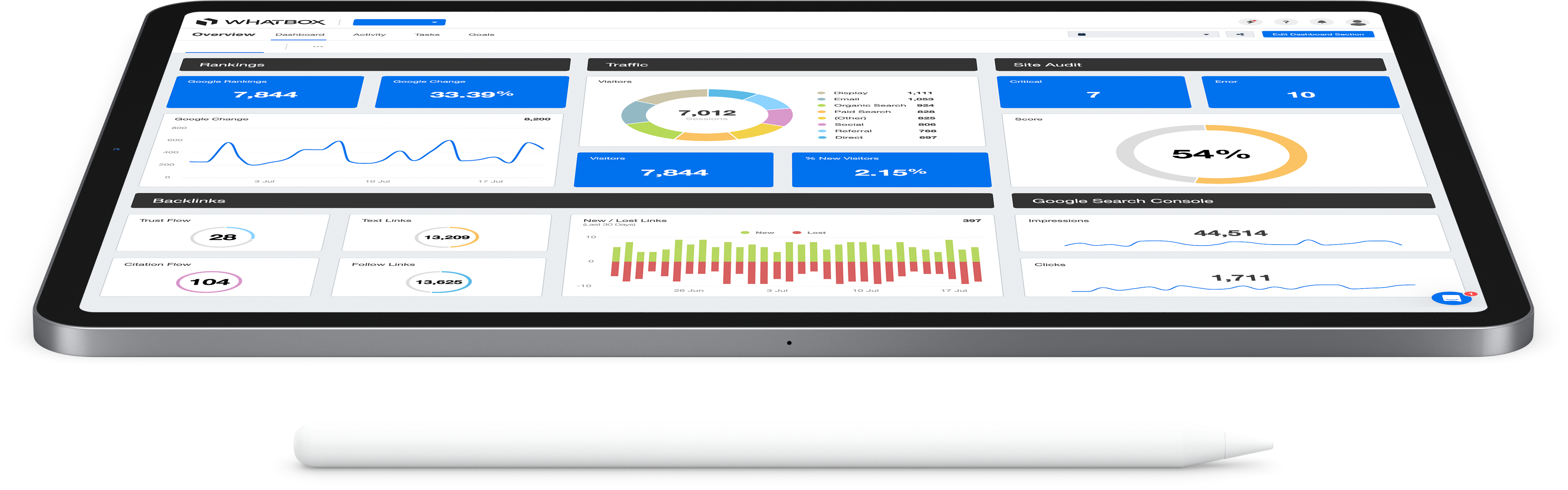
An SEO dashboard displays all of the essential elements of an SEO campaign in a real-time interface. It typically includes metrics such as keyword rank tracking, organic traffic, web conversions, backlinks built, and more. An SEO dashboard gives you all of the data you need to improve your performance in organic search.
2. Social Media Metrics
A social media dashboard helps you to manage your business online and social presence on multiple platforms in a single, comprehensive view. It makes you more efficient at monitoring multiple accounts.
3. Website Analytics
Analyzing customer behavior for your website can be tough, especially when you have to sift through data from various platforms.
Using a marketing dashboard that integrates Google Analytics data allows you to analyze website insights simply and concisely. The platform makes it easy to gain campaign performance insights by sorting pages based on crucial metrics like top exit pages, bounce rate, and user sessions.
4. Facebook Advertising Metrics
Hidden in your Facebook Ads manager is a wealth of data and insights ready to be tapped into. The posts shared by users, the engagement from followers, and the interactions on your ad copy all make up for data that you need to monitor to improve performance.
Monitoring and understanding your audience better assists you create stellar strategies, and reveals how well your campaigns are doing.
5. YouTube Metrics
Monitoring and analyzing the right YouTube video metrics is a necessity for the success of your campaigns. You need to be able to identify key metrics to measure the performance of your YouTube account(s) and the videos featured on those accounts.
6. Instagram Metrics
You need to see how your audience has grown over time and be up-to-date with post, story, and Reel updates.
You also need to have a trustworthy method of measuring post-performance. With the right dashboard that integrates Instagram analytics, your business will have the confidence you need to manage and monitor your Instagram campaigns.
7. Call Tracking Metrics
A call tracking dashboard is a single, unified platform that monitors relevant call metrics and KPIs and gets updated in real-time. Call tracking dashboards are useful to optimize and scale the performance of your marketing campaigns. Automatically collecting data from multiple sources allows you to identify the top marketing channels and compare the total number of leads from each platform.
Call tracking dashboards also provide visibility into your calls and conversions. The dashboard allows you to browse each lead’s information—including the name, phone number, time, location, and call recording. Finally, a call tracking dashboard helps you identify missed opportunities.
By analyzing the time of day or day of the week of missed calls, you can use this information to optimize your schedule and avoid missing out on valuable opportunities.
8. E-Commerce Metrics
You may or may not own an eCommerce brand or business. But if you do, you need a powerful eCommerce dashboard to track and measure your overall online store performance by automatically collecting and displaying data from various platforms in the most intuitive way possible.
This could and should include tracking data from Google Analytics, PPC campaign metrics, SEO rankings, and social media marketing performance alongside your Shopify eCommerce platform data.
9. PPC Metrics
If you’re running paid traffic, you need a PPC dashboard that displays data from all of your pay-per-click campaigns in real-time.
Data can be automatically collected from multiple ad platforms including Google Ads, Facebook Ads, Microsoft Ads, Instagram Ads, Spotify Ads, and more. Give your business a single place to monitor the performance of all of your paid campaigns in one place.
10. Google Local Metrics
Most business leaders, particularly local stores, restaurants, and service providers, underestimate the importance of maintaining and monitoring your local presence and their Google My Business accounts.
This includes ongoing posted updates, and more importantly, the intentionality of collecting positive reviews and responding to negative ones.
Closing Thoughts
As you might imagine, there are hundreds, if not thousands of KPI metrics that a business can choose to closely monitor. But focusing on all the metrics, or too many, will distract you from focusing on what’s MOST important, your key metrics. Your key metrics are the ones that have the biggest and fastest impact on your business, positively or negatively.
If you were flying a plane from Chicago to New York, be assured that 100 out of 100 pilots would agree that the compass and altimeter instruments would rank in the top 3 to 5 metrics to pay the closest attention to if you want to arrive safely at your desired destination.
Learn what’s most important to grow your business and protect you from harm. Then never take your eyes off those numbers ever again.

About the author.
Brian Webb is a 22-year entrepreneur, private investor, business & profit growth mentor, a B2B marketer, and the host of the Business Growth Show podcast.
In addition to managing a growing portfolio of businesses, Brian is the CEO of the award-winning marketing and business growth consulting agency in The Woodlands, Texas (Greater Houston Metroplex), Whatbox Digital, LLC.
You can find Brian on Apple, Google, Spotify, Pandora, iHeartRadio, and Amazon. Brian’s writings have been published and featured on NBC, ABC, CBS, FOX, and MarketWatch, and has been approved as a Forbes Business Council member and content contributor.
You may also recognize some of Brian’s anchor clients like Coca-Cola, Comcast, Coldwell Banker, Entrepreneur’s Organization, Hospital Corp of America, and Karbach Brewing, to name a few.